 Jincymol P
October 12, 2026
Today, the Wi-Fi network at a home works almost similar to a small business network. Mostly, a single router connects laptops, phones, smart TVs, security cameras, and voice assistants, while all of these run at the same time. That puts a lot of pressure on an average home router. As a result, testing a device carefully before it reaches the customer has become the most important thing.
This is where TR-398 testing comes in. It is the industry standard way to check how well a Wi-Fi access point performs in real homes, and it gives operators and device makers a shared, repeatable way to measure quality. As part of our Wi-Fi testing services, ThinkPalm offers TR-398 test cases based on the current Broadband Forum standard, so our customers can trust that their access points are ready for real-world use.
TR-398 test cases measure and compare the real-world performance of access points (APs) by operators and their OEM/ODM vendors. In this article, we will discuss how TR-398 testing works, TR-398 test cases, and the results to showcase how we make efforts to ensure the best home Wi-Fi experience for our customers. Before we go into these details, we shall briefly discuss the TR-398 standard and why it matters.
Definition
TR-398 testing is the industry standard way to check how well a Wi-Fi access point actually performs in real homes. It was created by the Broadband Forum, and it tests things like signal strength, speed, coverage, and stability. Operators and device makers use it to make sure their Wi-Fi products are ready for real customers before they ship.
TR-398 is an industry-standard test plan defined by the Broadband Forum. It helps benchmark and compare the capabilities of access points to make sure they deliver a strong Quality of Experience (QoE) for real users. The standard has grown a lot since it first launched in 2019, and it is now on its latest version, TR-398 Issue 3 Corrigendum 1, published in May 2025. It gives a full set of performance test cases with clear pass or fail requirements for 802.11n, 802.11ac, and 802.11ax (Wi-Fi 6) implementations, helping operators choose the right Wi-Fi-capable devices.
Major operators such as AT&T, BT, Comcast, and Deutsche Telekom have all played a part in shaping this standard. The Broadband Forum also runs a related certification program called BBF.398 Carrier-Grade Wi-Fi, which gives devices that pass TR-398 testing a way to be recognized through approved labs. In practice, operators requesting new Wi-Fi hardware and the OEMs supplying that hardware are the two groups that need TR-398 testing the most, since it gives both sides a shared benchmark to work from before a device is deployed.
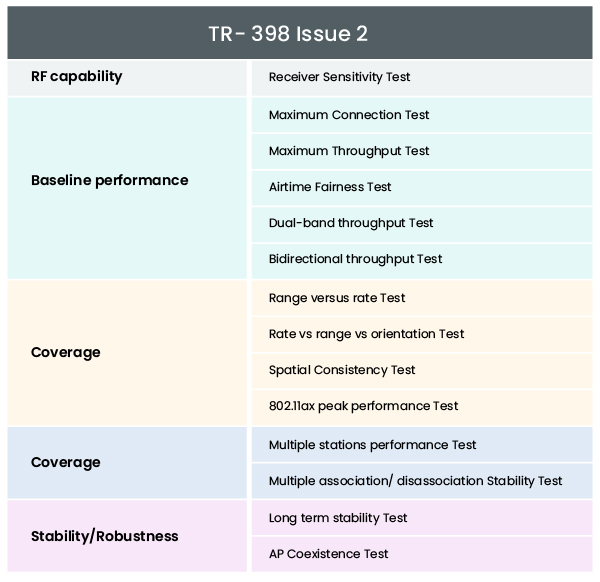
At ThinkPalm, with our TR-398 Issue 2 Wi-Fi testing plan, we provide a comprehensive set of tests to qualify the performance of Wi-Fi access points. For that reason, the primary goal of TR-398 is to provide a set of test cases and framework to verify the performance between Access Point (AP) and one or more Station (STA). It defines each test case as a scenario running between one or more Wi-Fi Stations (STA) and a Device Under Test (DUT).
If you are exploring TR-398 for the first time, this is a good moment to see how pre-compliance testing can increase ROI for wireless devices, since catching issues in a DUT-to-STA scenario early saves cost later in the certification process.
See how we helped an OEM validate access point performance through pre-certification testing.
Read Case Study →Like most technical standards, TR-398 does not stay still. The Broadband Forum releases new versions, called issues, every so often to keep up with new Wi-Fi technology and real-world network needs. Each issue builds on the one before it, adding new test cases or updating existing ones to match how homes actually use Wi-Fi.
TR-398 Issue 2 was an earlier version of the standard. It added support for testing 802.11ax, or Wi-Fi 6, and a lot of early industry content is still built around it. Since then, the standard has moved forward, and the version in use today is TR-398 Issue 3 Corrigendum 1.
Here is a quick look at what changed:
| Area | TR-398 Issue 2 | TR-398 Issue 3 Corrigendum 1 |
|---|---|---|
| Wi-Fi standards covered | 802.11n, 802.11ac, 802.11ax (Wi-Fi 6) | Adds Wi-Fi 6E (6 GHz band) support |
| Network setup | Single AP focus | Adds mesh network test cases |
| Load and quality testing | Not included | Adds Quality of Service (QoS) test cases |
| Delay testing | Not included | Adds Latency-under-Load testing |
| Band handling | Basic dual-band tests | Adds multi-band throughput testing |
TR-398 Issue 3 Corrigendum 1 is the version that is officially in force today, and it is a better fit for modern homes since it accounts for mesh systems, multiple bands, and the 6 GHz spectrum used by newer routers.
Looking ahead, the Broadband Forum has confirmed that TR-398 Issue 4 is currently in development. It is expected to bring formal test coverage for Wi-Fi 7, including features like Multi-Link Operation (MLO), 320 MHz channels, and 4K-QAM. Issue 4 has not been published yet, so Issue 3 Corrigendum 1 remains the current, official standard. OEMs planning Wi-Fi 7 devices should still keep an eye on this release, since some test equipment makers are already building tools aligned to the draft version ahead of its formal launch.
We at ThinkPalm, offer a fully automated TR-398 Issue 2 performance test suite. All the required test hardware and fully automated test software, along with PASS/FAIL, feature a fully packaged, easy-to-use, and affordable solution.
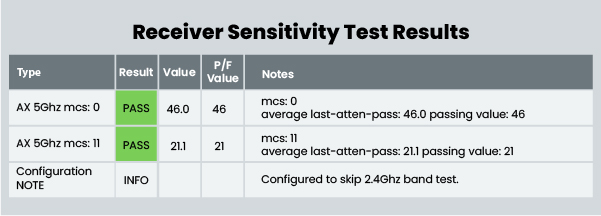
In the real world, the AP needs to handle different types of clients at various distances, transmitting at different data rates and power values. The APs receiver should be able to handle all these scenarios to communicate successfully with clients and achieve good throughput.
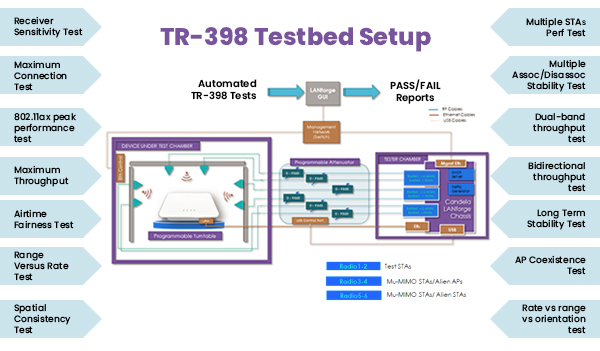
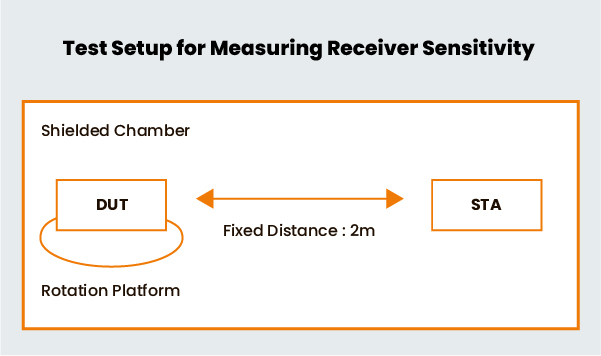
This Wi-Fi testing solution measures the receiver’s ability to receive and correctly demodulate weak signals. Further, it provides a simplified measurement of the receiver’s sensitivity relative to the total attenuation inserted between the DUT and the STA.
Receiver sensitivity matters even more on the 6 GHz band, since 6 GHz signals lose strength over distance faster than 2.4 GHz or 5 GHz. If you want to understand how devices actually find and use this band, see our breakdown of 6 GHz Wi-Fi discovery.
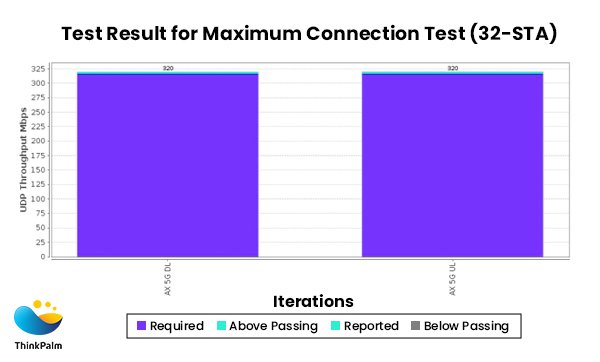
The test intends to verify that the Wi-Fi AP can support 32 STAs simultaneously with minimal packet loss and no disassociations taking place.
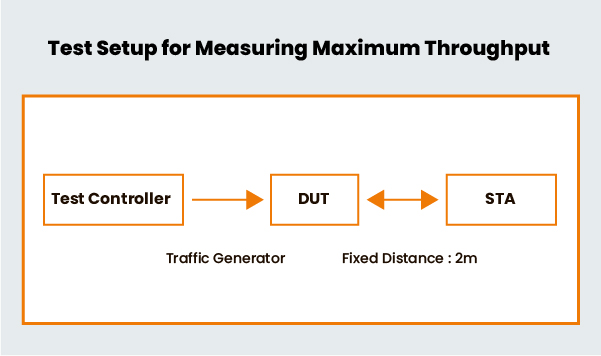
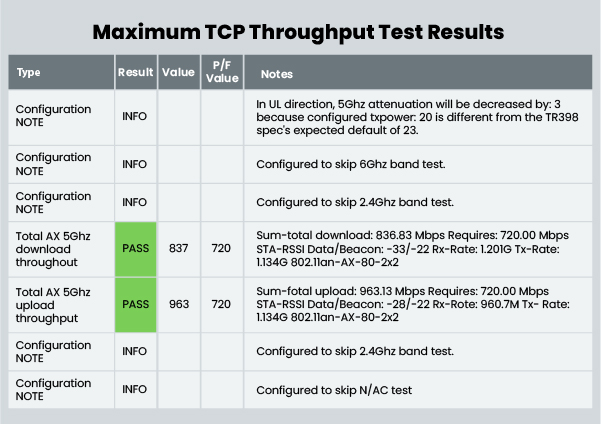
This Wi-Fi testing plan intends to measure the maximum throughput performance of the DUT. Also, it indicates the capability of a device to transmit data.
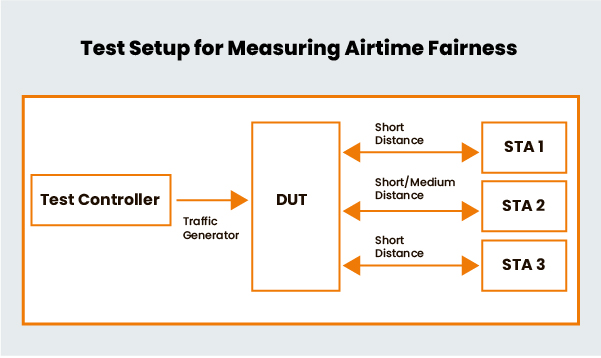
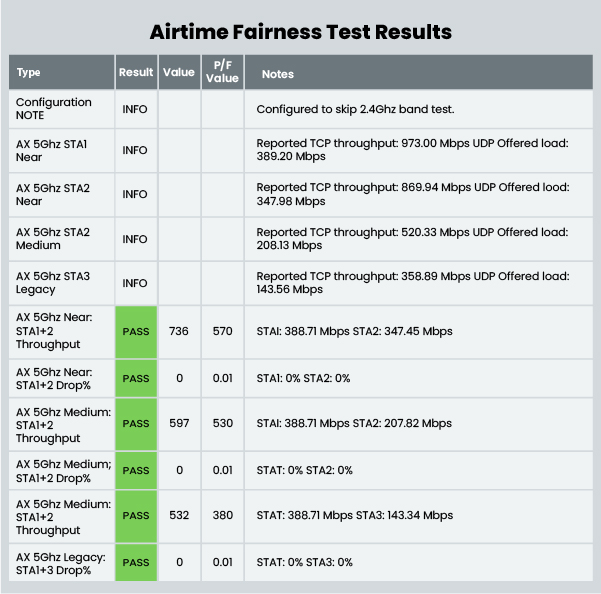
The test checks whether the Wi-Fi device ensures fair airtime usage among connected clients. It evaluates performance when handling a mix of newer and legacy (802.11a/b/g) standard clients.
Typically, 3 stations are used in this test.
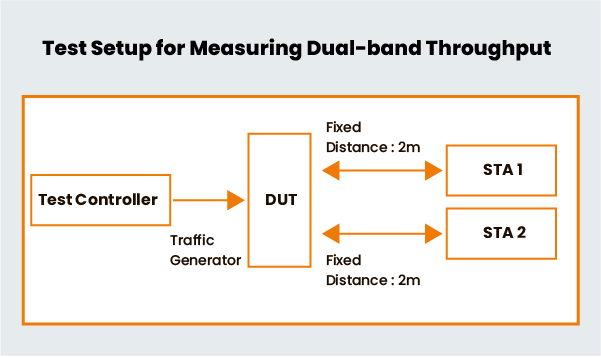
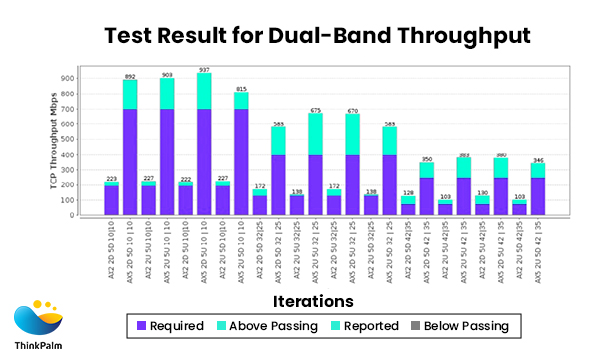
The test is intended to measure the throughput the DUT can support when concurrently connected to multiple stations on both 2.4GHz and 5 or 6 GHz bands. The purpose of this test is to detect cross-band interference.
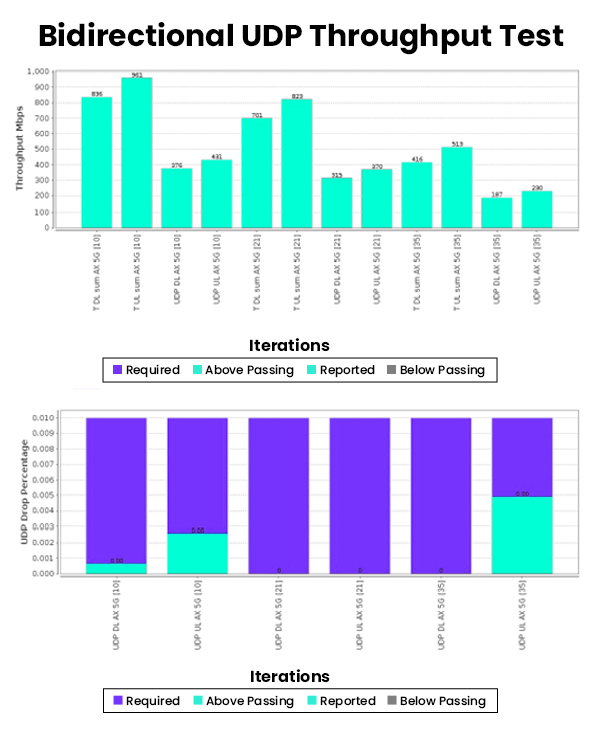
In bidirectional throughput Wi-Fi testing, the maximum throughput performance of the DUT is measured when both uplink and downlink traffic is running. Also, it checks that the packet loss ratio will not exceed the specified value when AP performs uplink and downlink transmissions simultaneously.
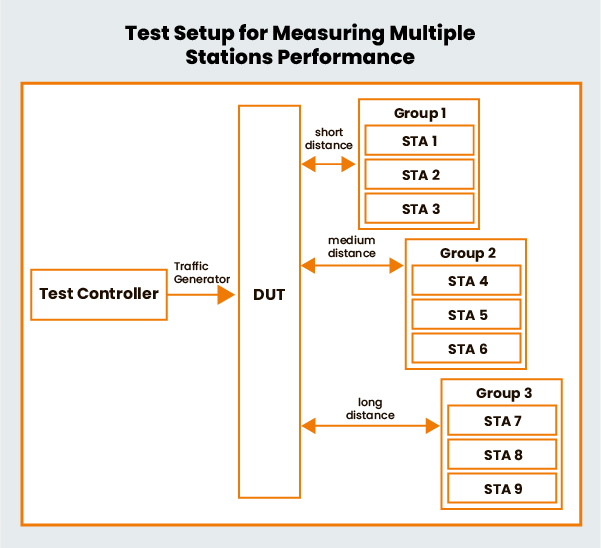
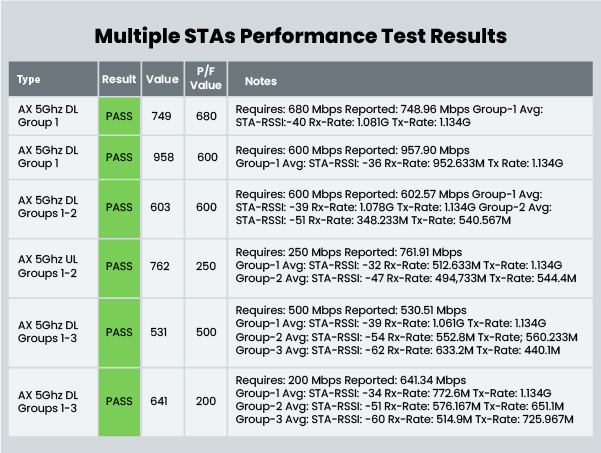
This Wi-Fi testing plan focuses on measuring the performance of the AP with multiple stations at different distances to emulate real-world behavior. There are three sets of three stations, with each group at a different emulated distance. Thus, in this case, the stability and performance of the connections are relatively important.
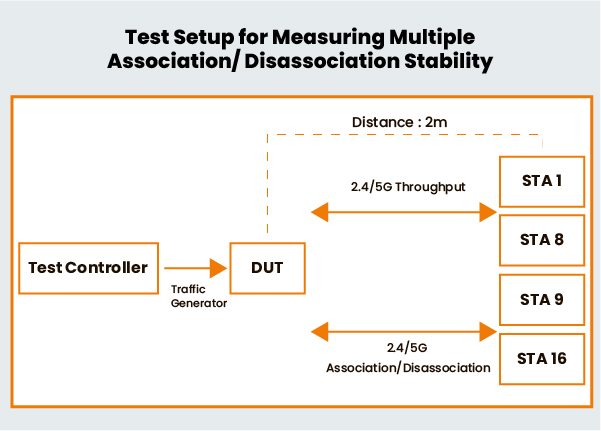
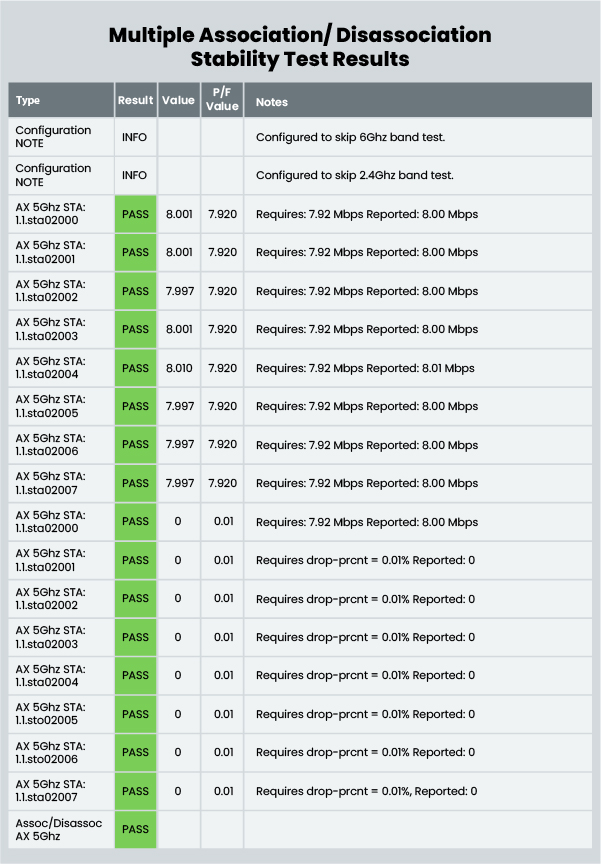
The test intends to measure the stability of Wi-Fi devices under a dynamic environment with frequent changes in connection status. A total of 16 stations are associated with the DUT. Eight handle packet transmission and reception, while the other eight undergo disassociation and re-association during the test.
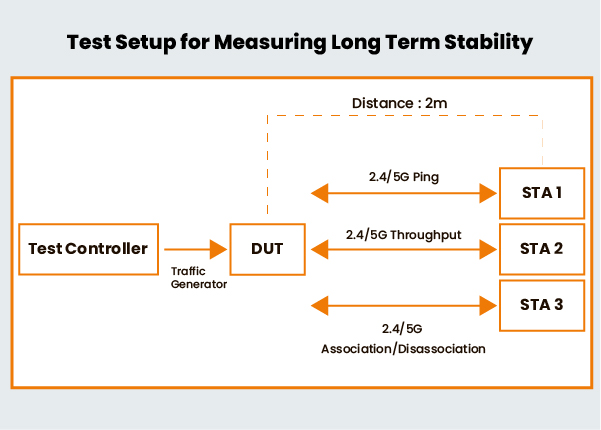
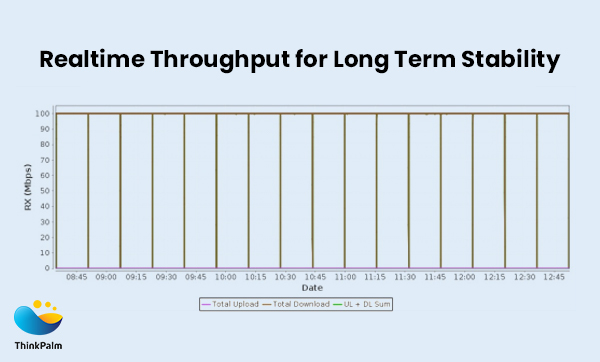
This test measures the stability performance of a Wi-Fi device under stress. It confirms the AP can consistently maintain high throughput and stability over a long test duration.
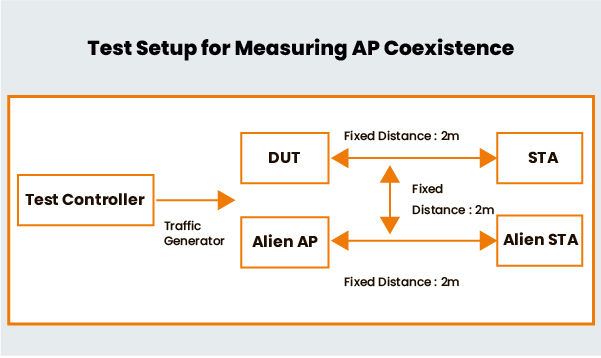
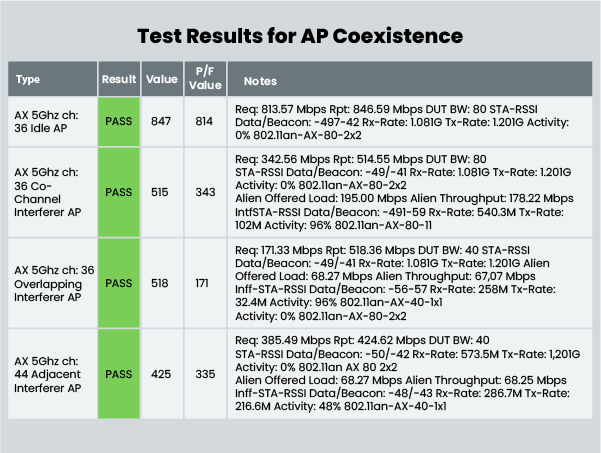
The Wi-Fi testing plan verifies the performance of DUT with existence of alien AP. The alien AP shall support the same Wi-Fi standard (802.11n/802.11ac/802.11ax). The test simulates how well an AP handles external interference, such as co-channel and adjacent-channel interference. It also checks whether the AP can maintain stability and performance under these conditions.
To see how this kind of testing plays out on next-generation hardware, read our breakdown of Wi-Fi 7 QoS scheduling tested under heavy load.
TR-398 coverage and stability testing evaluates how well an access point performs across different distances, angles, and time periods. It goes beyond testing under a single fixed lab condition.
The test intends to measure the rate control, baseband and RF chain performance of Wi-Fi devices at different signal levels. The attenuation of signals due to range increase is provided by attenuators.
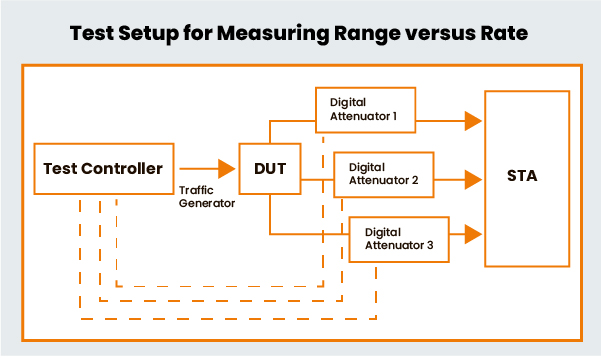
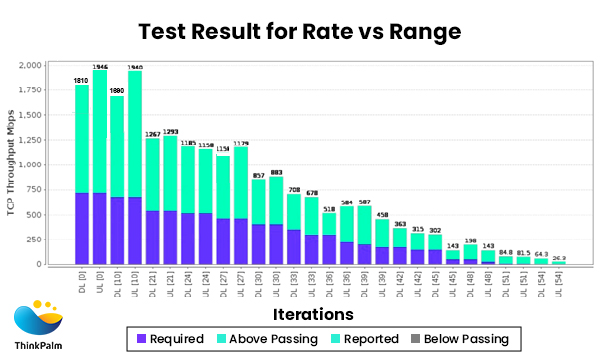
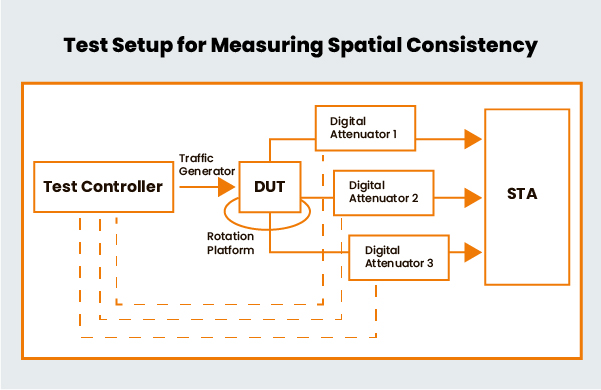
The test intends to measure the performance over the distance of the DUT. Also, it measures the performance of the AP at various antenna orientations using a programmable turn table with respect to the stations and at different emulated distances provided by attenuators. The test provides throughput and RSSI values related to signal and rotation plotted on a chart.
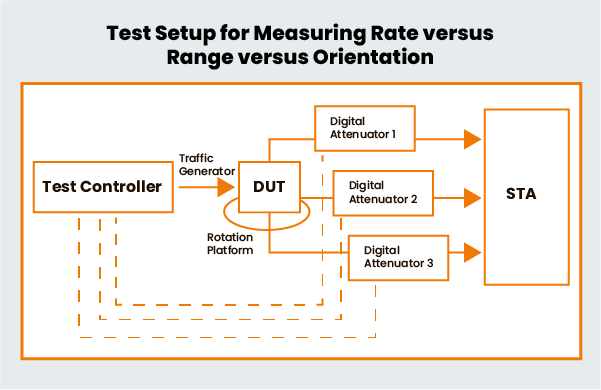
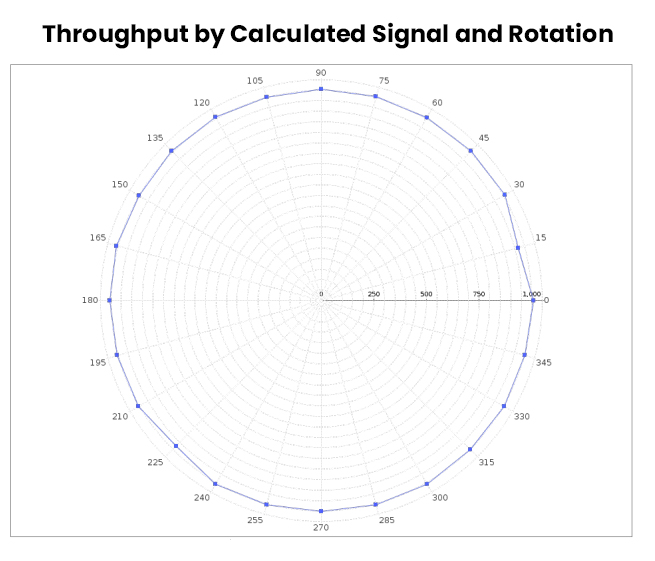
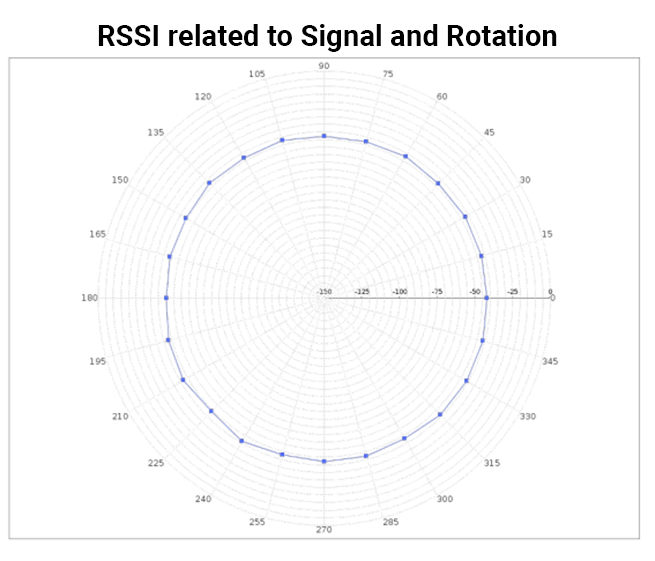
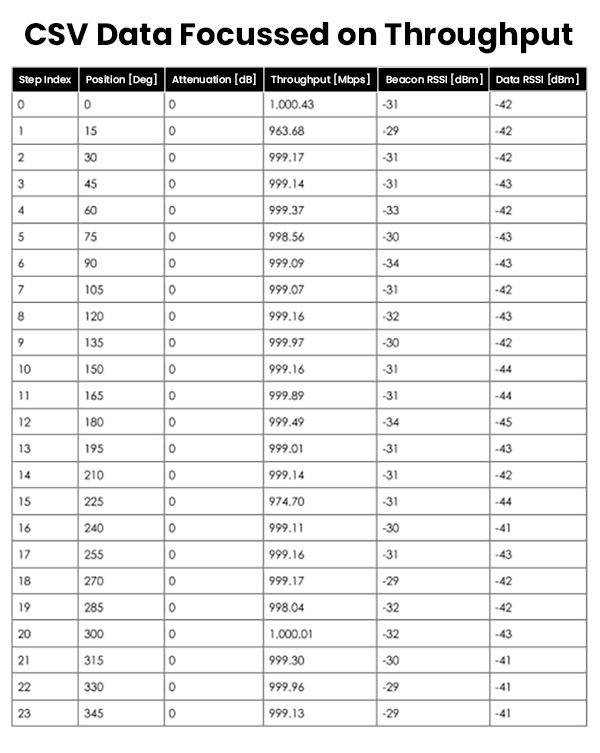
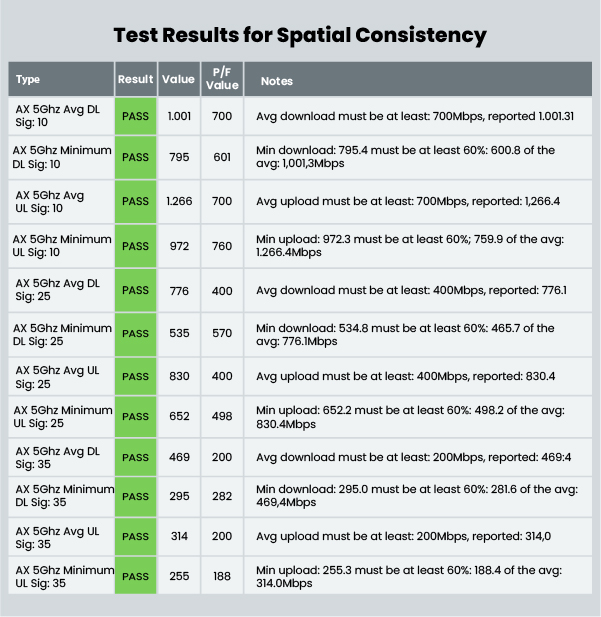
The test is to verify the Wi-Fi signal consistency in the spatial domain. Further, this checks if there is any single dead zone when the AP is at a specific angle that leads to low throughput. In this test, AP is examined in terms of performance and stability at predefined attenuation levels and angles as per the TR-398 standard.
Read how we assessed AP performance through Rate vs Range vs Orientation testing for a networking OEM.
Read Case Study →The test measures the maximum throughput performance of the DUT with a single station active. The AP should be configured for 160MHz on 5 GHz and 40 MHz on 2.4GHz bands. This Wi-Fi testing plan confirms the highest transmission performance in the 802.11ax mode.
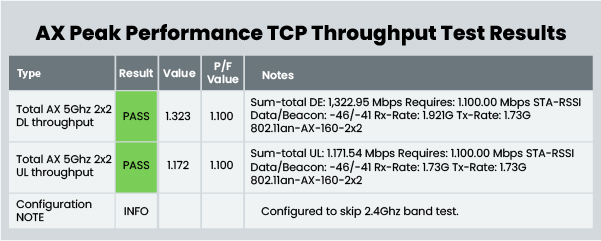
After analyzing this test plan and drawing on our Wi-Fi testing experience, we’re confident in its coverage. An access point that passes all these tests has a strong chance of delivering an excellent Wi-Fi experience in real-world deployments.
At ThinkPalm, with the help of the TR-398 standard, we test indoor Wi-Fi performance and support the build of home networks. This in turn helps in improving the broadband experience for our customers. We verify multiple performance, stability, and sensitivity factors related to Wi-Fi chipsets, using a test plan aligned with the latest TR-398 Issue 3 Corrigendum 1 requirements, and we are keeping an eye on TR-398 Issue 4 as it develops for Wi-Fi 7.
Experience the benefits of this TR-398 testing plan, and make sure your home Wi-Fi devices meet the quality and performance your customers expect. Reach out to our team to learn more about our TR-398 test plan for OEMs.
Jincymol P is an Embedded and Wi-Fi system professional working at ThinkPalm Technologies, and is interested in researching about recent developments in technology. She is an MS Scholar in Embedded Systems from University of Greenwich, UK. Her area of expertise includes embedded systems, wireless networks and Internet of Things.
One message is all it takes to get started. Tell us what you need, and we’ll take it from there, no long forms, no waiting around.

